Monday, March 31, 2008

From PostSecret

Someone posted this on PostSecret.


Eggs don't bother me, but I do know exactly how old my lost child would be and it can tear me to pieces to see a child that age.

Wednesday, March 26, 2008

Mencken on Doubt

I was once told by a Catholic bishop that whenever a priest comes to his ordinary with the news that he was begun to develop doubts about this or that point of doctrine, the ordinary always assumes as a matter of fact that a woman is involved. It is almost unheard-of, however, for a priest to admit candidly that he is a party to a love affair: he always tries to conceal it by ascribing his desertion to theological reasons. The bishop said that the common method of dealing with such situations is to find out who the lady is, and then transfer the priest to some remote place, well out of her reach. If, after a year or two there, he still harbors his doctrinal doubts, he is permitted to withdraw quietly from his sacerdotal office and to marry her in a respectable manner, though without the blessing of the church.

— Henry Louis Mencken


From “Minority Report: H.L. Mencken’s Notebooks”, by H.L. Mencken; Alfred A. Knopf, New York, 1956, note #93.

Friday, March 21, 2008

Where are we today?

“The mother with the child at her breast is the grand emblem of cosmic life.”
— Decline of the West, II : 362


In 1194, Henry VI, Emperor of the Germans, received word of a strange prophecy from a Cistercian monk. Blessed Joachim of Fiore, mystic, historian, and abbot, and not a friend to the Hohenstaufen dynasty, informed the Emperor that he was to expect the birth of a son. This was a wild prediction, for Henry’s wife, Constance of Hauteville was nearly forty and had yet to produce any children after ten years of marriage. Astoundingly, however, they mystic’s prophecy proved to be true!

[Full disclosure: Constance of Hauteville is my third cousin, twenty-six times removed.)

Constance was the last surviving child of Roger II, King of Sicily, Prince of Taranto, and duke of Apulia. When she had been betrothed to Henry, she was thirty and he only twenty-one, it looked as though she would bring nothing more to the marriage than an immense dowry (perhaps the greatest seen since Roman times) and a truce between the Normans and Hohenstaufen in the south of Italy. In the intervening years, however, first her brothers and then all the legitimate male heirs of the House of Hauteville had died off, and she was now the legitimate claimant to the Kingdom of Sicily (which was at that time perhaps only second to the Angevin domain in prosperity and culture). This inheritance had to be won, however, as her bastard nephew Tancred had usurped the kingdom upon the death of Roger’s grandson in 1189.

It was only when Henry had assembled a large contingent of German lords and begun marching down the length of Italy in the late summer of 1194 that his wife found out about her condition. Believing this to be her only chance for motherhood, Constance was to proceeded south carefully, sending Henry and his great host on ahead. She had already reached the town of Jesi in the Marches, near Ancona, when she received news of Henry’s successful capture of Palermo in November. Here she rested and waited for her time to come upon her.

Being of what today is rather late for a first birth and was in her day an inconceivably advanced age, Constance took precautions to insure that there would be no questioning the maternity of her child. She caused a pavilion tent to be set up in the town square of Jesi and invited all the matrons of the town, and any bishop who wished, to see her delivered of her child. (Reports vary, but at least three and perhaps as many as seventeen bishops witnessed the birth.) The day after Christmas, 26 December 1192, she brought forth a son who was later baptized Frederick. Two days later, she ordered a Te Deum mass to be said at the cathedral of Ancona. She sat in the very front pew and nursed her child there for all to see. Her breasts were described as “fairly bursting with milk.”


I think of this historical incident, from the very springtime of our Western Culture, whenever I hear of one of our modern bourgeois women who claims she somehow “cannot” breast-feed. (Of course, if there actually were women who organically could not breast-feed, their race would have died out.) Constance was heroic in her motherhood. She knew that it was her duty to her child dispel any question of his legitimacy and she took every measure, forsook privacy, sacrificed her dignity to ensure this. She did this out of blood feeling, precisely that idea of motherhood as a vocation that modern woman lacks.

When the ordinary thought of a highly cultivated people begins to regard “having children” as a question of pro’s and con’s, the great turning-point has come... When reasons have to be put forward at all in a question of life, life itself becomes questionable. At that point begins prudent limitation of births. In the Classical world the practice was deplored by Polybius as the run of Greece, and yet even at his date it had long been established in the great cities; in subsequent Roman times it became appallingly general. At first explained by the economic misery of the times, very soon it ceased to explain itself at all. And at that point too, a man’s choice of the woman who is to be not mother to his children as amongst peasants and primitives, but his own “companion for life,” becomes a problem of mentalities. The Ibsen marriage appears, the “higher spiritual affinity” in which bath parties are “free” — free, that is, as intelligences, free from the plantlike urge of the blood to continue itself ...The primary woman, the peasant woman, is mother. The whole vocation towards which she has yearned from childhood is included in that one word. But now emerges the Ibsen woman, the comrade, the heroine of a whole megalopolitan literature from Northern drama to Parisian novel. Instead of children she has soul-conflicts; marriage is a craft-art for the achievement of “mutual understanding.” ...

At this level all Civilizations enter upon a stage, which lasts for centuries, of appalling depopulation. The whole pyramid of cultural man vanishes. It crumbles from the summit, first the world-cities, then the provincial forms, and finally the land itself, whose best blood has incontinently poured into the towns, merely to bolster them up awhile. At the last, only the primitive blood remains, alive, but robbed of its strongest and most promising elements.
— Decline of the West, II : 10/

Which brings me to an absolutely emblematic incident. I was with my family at North Bridge just before Christmas to get a photo of the kids with Santa Claus. Waiting in line ahead of us was a very well dressed woman with large, sumptuous bosoms. She was thick-set, with shapeless legs and no buttocks to speak of. She had drab, lifeless, bleach-blond hair, frog-eyes, and a pronounced double-chin. In short, her only selling point were those fabulous titties. Perhaps she has a sparkling personality, or a rapier-like wit, or an acute intelligence — but I doubt it. I would wager any sum that the only reason her quite evidently prosperous husband married her was for those extravagant, ostentatious boobs. She had a newborn child in a stroller and she was discussing how they would pose the babe for a photograph of his first visit to Santa. It was at this juncture that the infant awoke, crying. With much fuss and agitation the new mother picked up the child, took him in her arms, and popped a bottle of formula into his mouth. Those spectacular mammaries, made by God to give sustenance to her whelp, were useless, reduced to being a consumer item, furnishing not milk, but mere licentious inspiration to her husband.

The fatal turning point has come and gone.

Tuesday, March 18, 2008

Spengler on Confession


No religious institution has brought more happiness to men than the sacrament of confession.

Tuesday, March 4, 2008

His Kingdom is not of this world!

Got this query in my e-mail:

Cardinal George is interested in your input! In light of the Year of Spirituality, the Cardinal's third question this year for the parishioners of the Chicago Archdiocese is:

How does working for Social Justice strengthen faith in God?

Quite simply, it doesn't. I spent the first twenty-five years of my life as a Godless Communist working for social justice and it never did anything to foster in me any kind of belief in God. I became a Catholic for entirely personal, philosophical reasons that in no way sprung from my longstanding and continuing efforts for Social Justice.

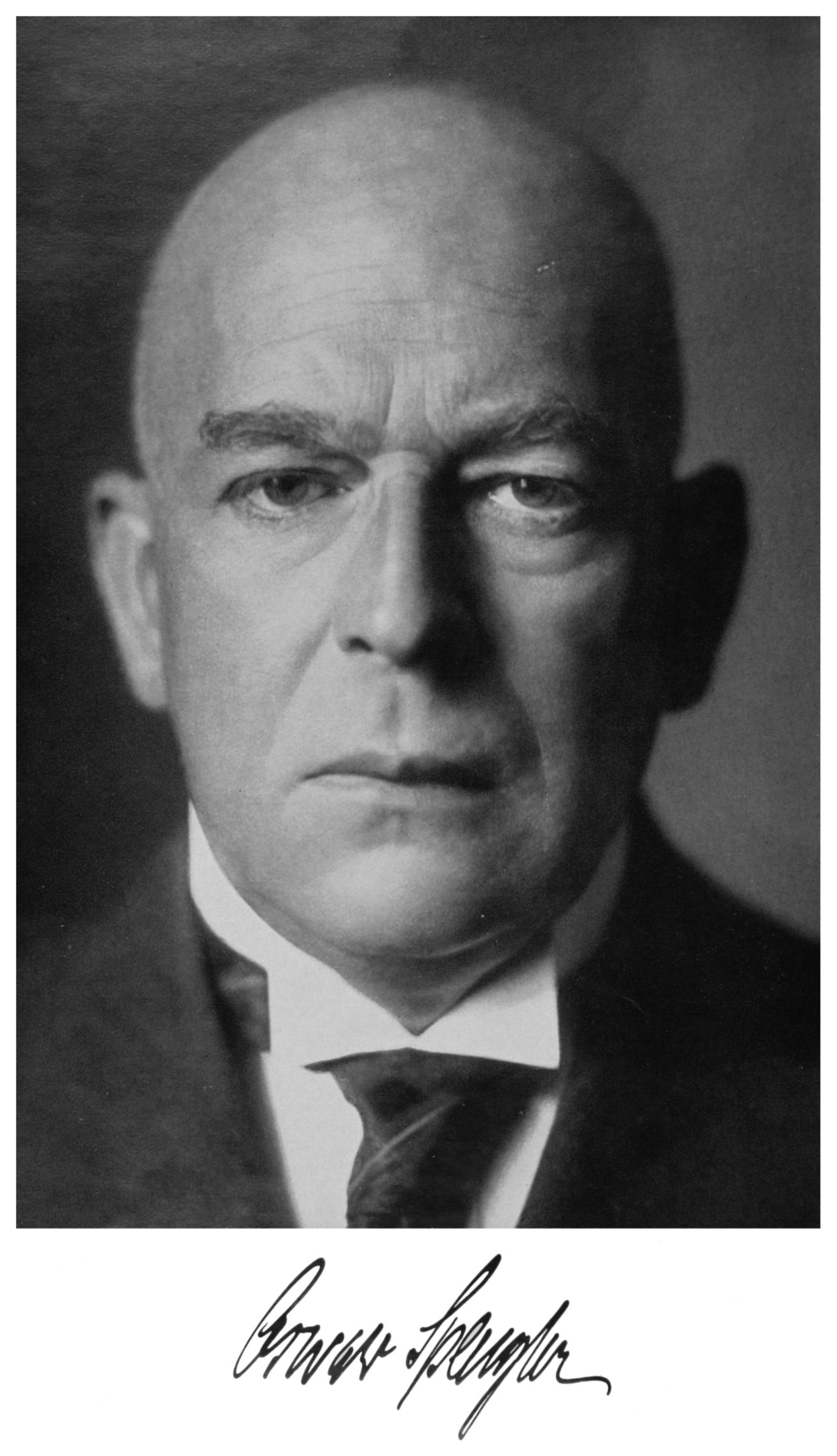
Once again, Oswald Spengler has it right:

To ascribe social purpose to Jesus is a blasphemy. In Jesus we have the direct opposite. “Give unto Cæsar the things that are Cæsar’s” means: “Fit yourselves to the powers of the fact-world, be patient, suffer, and ask not whether they are ’just’.” What alone matters is the salvation of the soul. “Consider the lilies” means: “Give no heed to riches and poverty, for both fetter the soul to the cares of this world.” “Man cannot serve both God and Mammon” — by Mammon is meant the whole of actuality. It is shallow, and it is cowardly, to argue away the grand significance of this demand. Between working for the increase of one’s own riches, and working for the social ease of everyone, he would have felt no difference whatsoever. When wealth affrighted him, when the primitive community in Jerusalem — which was a strict Order and not a socialist club — rejected ownership, it was the most direct opposite of “social” sentiment that moved them. Their conviction was, not that the visible state of things was all, but that it was nothing: that it rested not upon appreciation of comfort in this world, but on unreserved contempt of it. Something, it is true, must always exist to be set against and to nullify world fortune, and so we come back to the contrast between Tolstoi and Dostoyevski. Tolstoi, the townsman and Westerner, saw in Jesus only a social reformer, and in his metaphysical impotence — like the whole civilized West, which can only think about distributing, never renouncing — elevated primitive Christianity to the rank of a social revolution. Dostoyevski, who was poor, but in certain hours almost a saint, never thought about social ameliorations — of what profit would it have been to a man’s soul to abolish poverty?

Wednesday, February 27, 2008

A Stunning Admission


“When I came of age in the seventies, it was still pretty cool to be able to offer a young man the actual presence of a naked, willing young woman. Today, real naked women are just bad porn.”

— Feminist Naomi Wolf

Tuesday, February 19, 2008

Jim Wallis: Bourgeois Liberal


So, I went to see Jim Wallis today.

People are always telling me that I would really like him, so I've been pretty diligent in checking him out. I've looked over his web site, I've read his book ("God's Politics: Why the Right Gets It Wrong and the Left Doesn't Get It" HarperSanFrancisco, San Francisco, 2005), and today I went to hear him speak.

His basic message is that "politics is broken" and that we need to be governed from a "new moral center." He said that for some time the religious vote had been co-opted by the Religious Right and that what we needed was a genuinely Christian politics that was neither right nor left. He said that it was immoral to argue about trivialities like homosexual marriage when we need to address real issues like global warming, the moral scandal of poverty, and genocide in Darfur. He had a few other things to say:

• "A Gospel that isn't good news for the poor isn't good news at all."
• "Budgets are moral documents."
• "We need to find common ground by going to higher ground."

The chestnuts were falling thick and fast, weren't they? And that's pretty much the problem I've had with him. He's all bromides about what's wrong with politics and no actual program of how to fix it. So, when it came time for questions, I put it to him. "I've read your book, I've heard you speak, and I still feel that I don't know what your program is. What measures, exactly, do you favor?"

Now, he's a nice guy, well meaning, sincere, and he really believes in what he's doing. And so he threw out three issues that he wanted to see addressed:

1] Abortion is a divisive issue with people of faith on both sides of the issue, but we can all agree that it would be a good thing to decrease the number of abortions. So he favors better access to birth control, easier adoptions, more support for single mothers.

2] The British government has vowed to reduce poverty by 50% over the next ten years. We should do that.

3] We need immigration reform since the present system is broken.

There he is, ladies and gentlemen, Jim Wallis on the record trying to bridge the gap between right and left and lead us up to higher ground. Is this really a new path, or just more Bourgeois Liberalism? Let's see ...

Abortion: Okay, reducing abortion is a laudable goal, one that just about everyone would sign on to. But these measures: aren't they all liberal measures? Where are the conservative measures like parental consent laws, bans on late-term abortion, or rigorous enforcement of statutory rape laws (as a high percentage of teenage pregnancies are caused by older men)? And, aren't all of these measures like pushing on a string? Aren't they all let’s do this and then hope that people don't have abortions?

Poverty: Yeah, poverty's bad and, hey, I'm against it. But so is welfare. Wallis isn't very clear here and that makes me suspect that what he's calling for is more government hand-outs (like that aforementioned "support for single mothers"). Being working class myself, I favor full employment as a cure for poverty. That's right: government public works and make-work programs. I think this is much more in line with the Biblical injunction "if any man will not work, neither let him eat" (2 Thessalonians 3:10) than doling our way out of poverty.

Immigration: Oh, sure, we need "reform," but what kind of reform? I found this on the Sojourners web-site:

The current U.S. immigration system is still broken. Families are still in jeopardy, workers are still being exploited, and the border is far from secure. As Christian churches, organizations and leaders, we are more committed than ever to holding our politicians accountable to the values they profess: values of family integrity and economic progress.



Now, again that's pretty opaque, but does it feel like they want to close the borders and enforce the law, or does it sound like they want to give my job away to an economic refugee from the Third World?

To conclude: I have always found that whereas conservatives are blind to issues of social justice, liberals are blind to issues of personal sin. Poverty, for instance, is caused both by an unfair economic system that exploits the working classes and personal irresponsibility. Conservatives never acknowledge that the system is stacked against the worker, while liberals never admit that even in a perfect world numbers of people are simply shiftless and don't deserve to be prosperous.

Which pattern does Jim Wallis fit?

I think it's clear. Far from advocating a third way "above right and left," Jim Wallis is simply a bourgeois liberal of the old school who has dressed up the same old tired nostrums in Christian garb.